Overview
The City of Richmond is currently implementing the 6th Housing Element Update (2023–2031). Per the Regional Housing Needs Allocation (RHNA), Richmond must plan for 3,614 new housing units during this cycle. The City of Richmond is required to track all units that are entitled, permitted, and completed throughout each House Element Cycle. However, only units that receive building permits are considered when assessing progress towards the City’s RHNA goals. When counting progress, cities include what is known as the "projection period," the time between June 30, 2022, and January 1, 2023. Therefore, the data below reflects progress made between June 30, 2022, and December 2024.
Data Dashboard
This dashboard provides a visual summary of Richmond's progress towards meeting its Regional Housing Needs Allocation (RHNA) and highlights notable achievements in implementing the Housing Element. See the California Department of Housing and Community Development Housing Element Implementation and APR Dashboard for more.
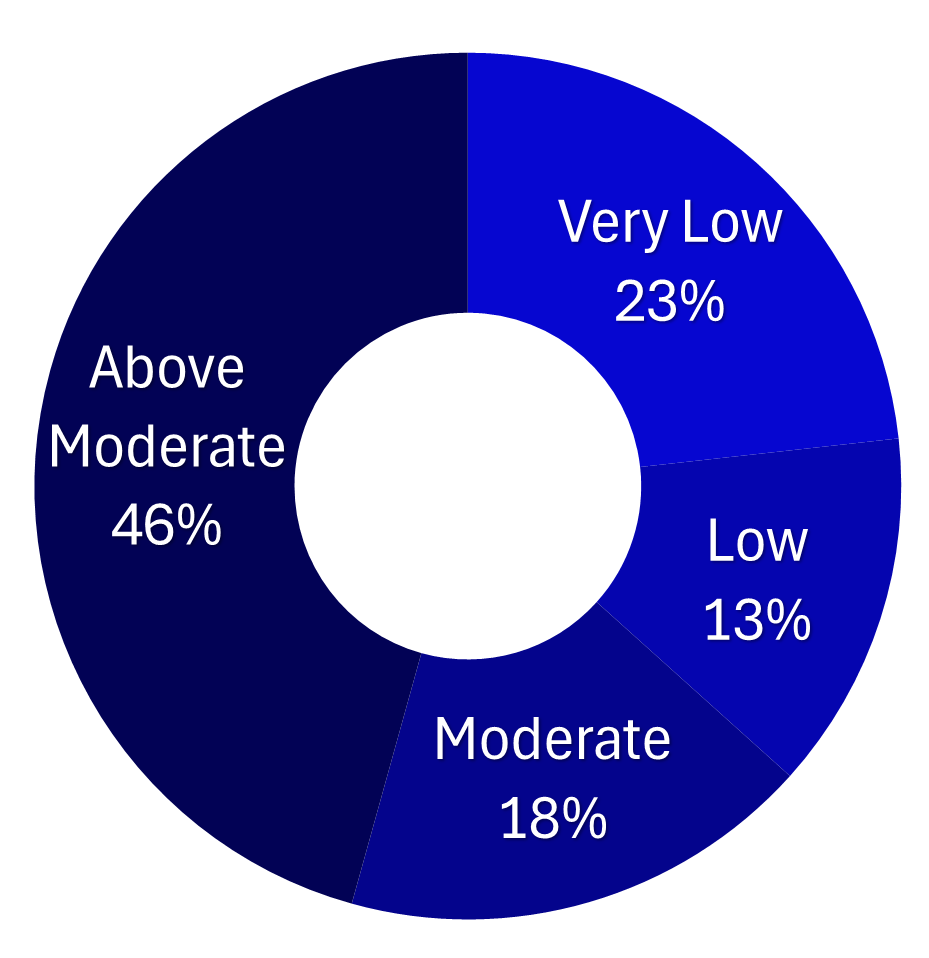
1. RHNA Allocation by Income Level |
2. Progress on RHNA Goals |
| Income Categories | RHNA Goal | Units Permitted | Progress Toward Goal |
| Above Moderate | 1,651 | 278 | 16.8% |
| Moderate | 638 | 24 | 3.8% |
| Low | 485 | 10 | 2.1% |
| Very Low | 840 | 14 | 1.7% |
| All Units | 3,614 | 326 | 9.0% |
3. Development Pipeline Snapshot |
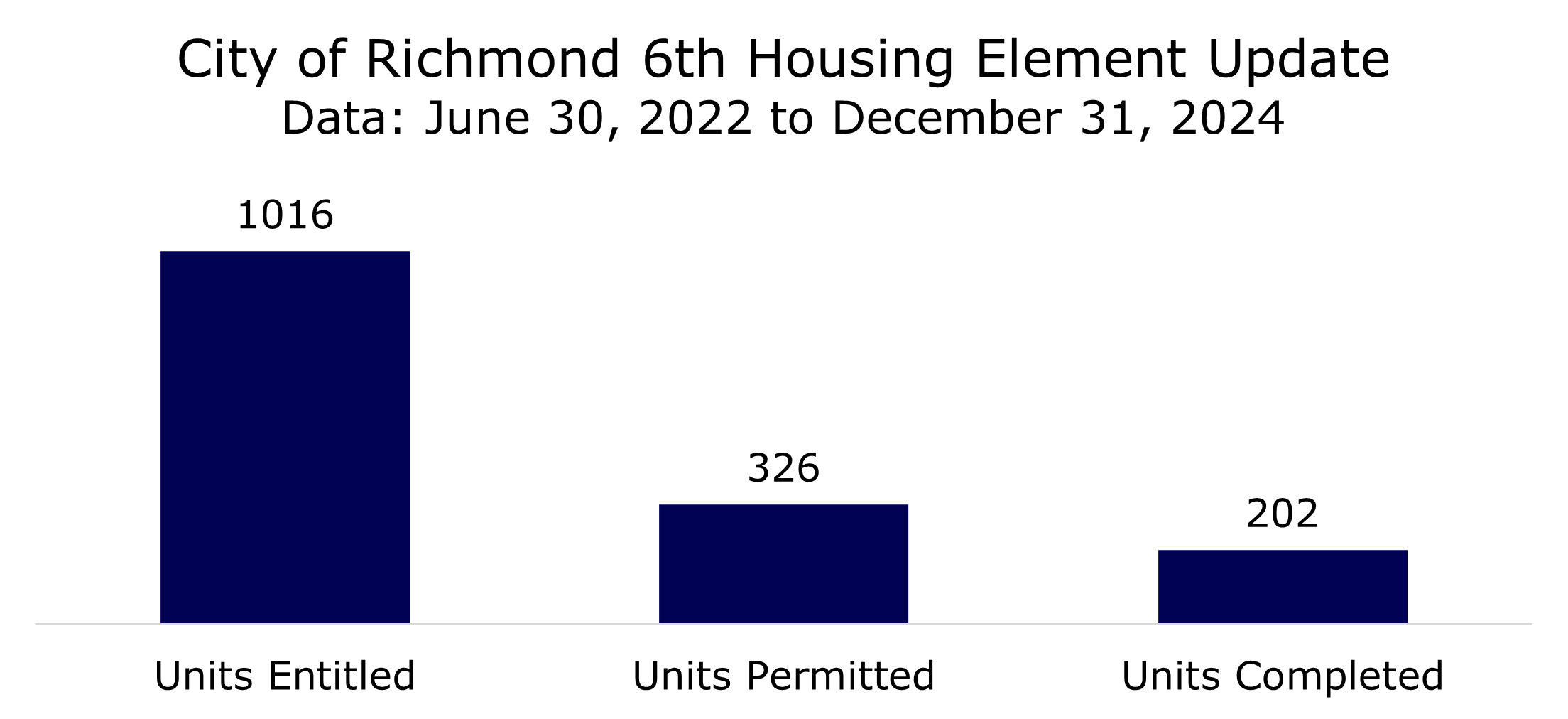
In addition to units that have been Permitted, the city also tracks the units that have been Entitled and Completed.
4. Development Pipeline by Income Level |
| Income Categories | Entitled | Permitted | Completed |
| Above Moderate | 283 | 278 | 200 |
| Moderate | 77 | 24 | 2 |
| Low | 419 | 10 | 0 |
| Very Low | 237 | 25 | 0 |
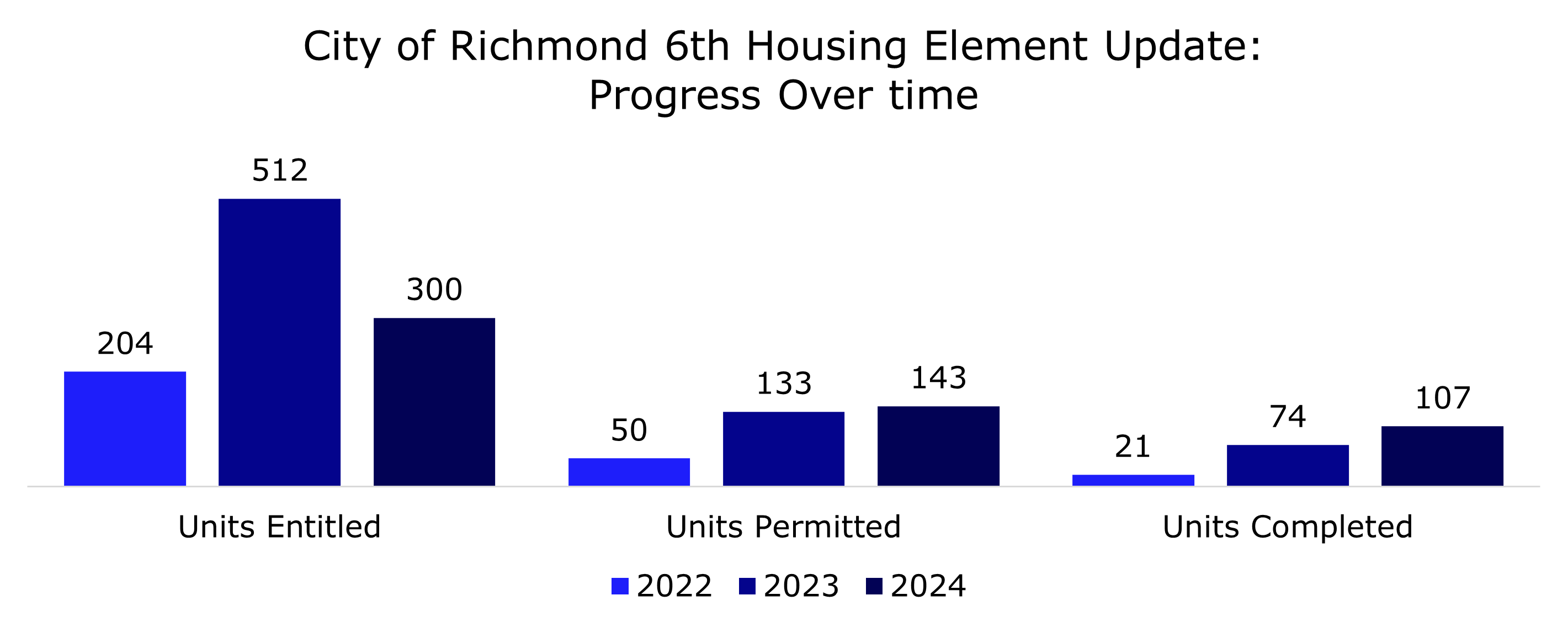
6. Permits Issued by Building Type |
| Unit Type | Entitled | Permitted | Completed |
| 5+ | 742 | 84 | 0 |
| ADU | 245 | 157 | 109 |
| 2 to 4 | 14 | 12 | 0 |
| SFD | 14 | 51 | 80 |
| SFA | 1 | 22 | 13 |
| MH | 0 | 0 | 0 |
| Total | 1016 | 326 | 202 |
- As of January 1, 2025, Richmond has Permitted 326 housing units - approximately 9% of the total RHNA allocation 3,614 units for the 6th Housing Element Cycle (2023-2031).
- 54% of the units required under the RHNA allocation are designated for households earning less than 120% of the Area Median Income (AMI), or $191,750 for a four-person household in Contra Costa County (as of 2025).
- Accessory Dwelling Units (ADUs) represent a significant share of above-moderate housing progress – accounting for 157 of the 278 permitted units (56%) and 109 of the 202 completed units (54%). Because ADUs cannot be deed-restricted under state law, cities cannot guarantee that they serve lower-income households. For this reason, ADUs are typically reported as “above moderate.”
- Since the start of the 6th Cycle, the Planning Division has issued 1,016 entitlements. 326 units (32% of entitled units) have applied for and received a building permit from the Building Division, and 202 units (20% of entitled units) have been completed and received certificates of occupancy.
- ADUs are the only unit type with consistent completions to date, playing an important role in providing additional housing units in the City of Richmond. For more data on ADU production from 2019 to present, please visit the City’s ADU webpage.
- While the number of completed units at this stage is modest, the City remains committed to fostering an environment that supports new housing production, especially for lower-income residents. Although the City does not directly build housing, it is actively implementing the Housing Element goals to promote new housing construction, facilitate diverse housing types, and remove constraints to housing development. Visit our Housing Element webpage for more information on our goals for this 6th Cycle.
- The City has demonstrated its commitment in this Housing Element cycle. To date, it has issued 1016 Entitlement permits, representing approximately 28% of the RHNA allocation. Notably, 656 of those units (65%) are designated for households earning less than 80% of the Area Median Income (AMI), or $125,050 for a four-person household in Contra Costa County (as of 2025).
Glossary
Overview of the Housing Element and Regional Housing Needs Allocation Processes
All jurisdictions in California are required to develop plans to meet the housing needs of their present and future residents. To determine housing needs, the State Department of Housing and Community Development works with regional planning bodies -- in Richmond’s case, the Association of Bay Area Governments (ABAG) -- and other state departments to analyze population trends and housing conditions within each region. Based on this analysis, a regional housing need determination (RHND) is developed.
To pave the way for the development of housing units in alignment with the RHND, the regional planning body allocates housing development targets to individual jurisdictions based on an HCD-approved methodology. Each jurisdiction must develop a plan to meet the portion of the Regional Housing Needs Allocation (RHNA) that has been allocated to it. This plan is the Housing Element. There are many laws governing the RHND, the RHNA, and the Housing Element update process, which are collectively known as the Housing Element Law.
Richmond is currently implementing the City’s 6th Housing Element Update, which covers the years 2023-2031. Per the RHNA, Richmond must plan for 3,614 new housing units between 2023 and 2031. In addition to constructing more housing and preserving existing housing, the Housing Element also outlines strategies to protect residents from displacement and prevent homelessness, close the gap between market-rate and affordable housing, expand resources for unhoused residents, and promote neighborhood stability and health. Read the full 2023-2031 Housing Element for more details on goals and actions.
Income Category
The projected housing needs are categorized by income level, based on definitions outlined in the California Health and Safety Code (§50079.5). HCD uses Area Median Income (AMI) to calculate income categories, which considers household size. See current AMI limits for Contra Costa County on the HCD website.
- Very low includes households that make less than 50% AMI
- Low includes households that make between 50% and 80% AMI
- Moderate includes households that make between 80% and 120% AMI
- Above Moderate includes households that make more than 120% AMI
Project Status
- Entitled units are those that have received all the required land use approvals necessary for the issuance of a building permit.
- Permitted units have been found to comply with all health, safety, and building code standards. The issuance of a building permit signals that construction on a project may begin - at this time, the unit is considered “permitted”. Only building permits for the construction of new housing units may be counted as progress towards the goals established by the Regional Housing Needs Allocation.
- Completed units have passed a final building inspection, which checks to ensure that the unit is in compliance with codes, the approved plans, and any conditions of approval, signaling that the unit is ready for occupancy.
Unit Types
- Single Family-Detached Unit (SFD) – A one-unit structure with open space on all four sides. The unit often possesses an attached garage.
- Single Family-Attached Unit (SFA) – A one-unit structure attached to another unit by a common wall, commonly referred to as a townhouse, half-plex, or row house. The shared wall or walls extend from the foundation to the roof with adjoining units to form a property line. Each unit has individual heating and plumbing systems.
- 2-, 3-, and 4-Plex Units per Structure (2-4) – A structure containing two, three, or four units and not classified as single-unit attached structure.
- 5 or More Units per Structure (5+) – A structure containing five or more housing units, also known as “Multifamily Housing Projects.”
- Accessory Dwelling Unit (ADU) – A unit that is attached, detached, or located within the living area of an existing dwelling or residential dwelling unit which provides complete independent living facilities for one or more persons. This category also includes Junior ADUs.
- Mobilehome Unit/Manufactured Home (MH) – A one-unit structure that was originally constructed to be towed on its own chassis.